

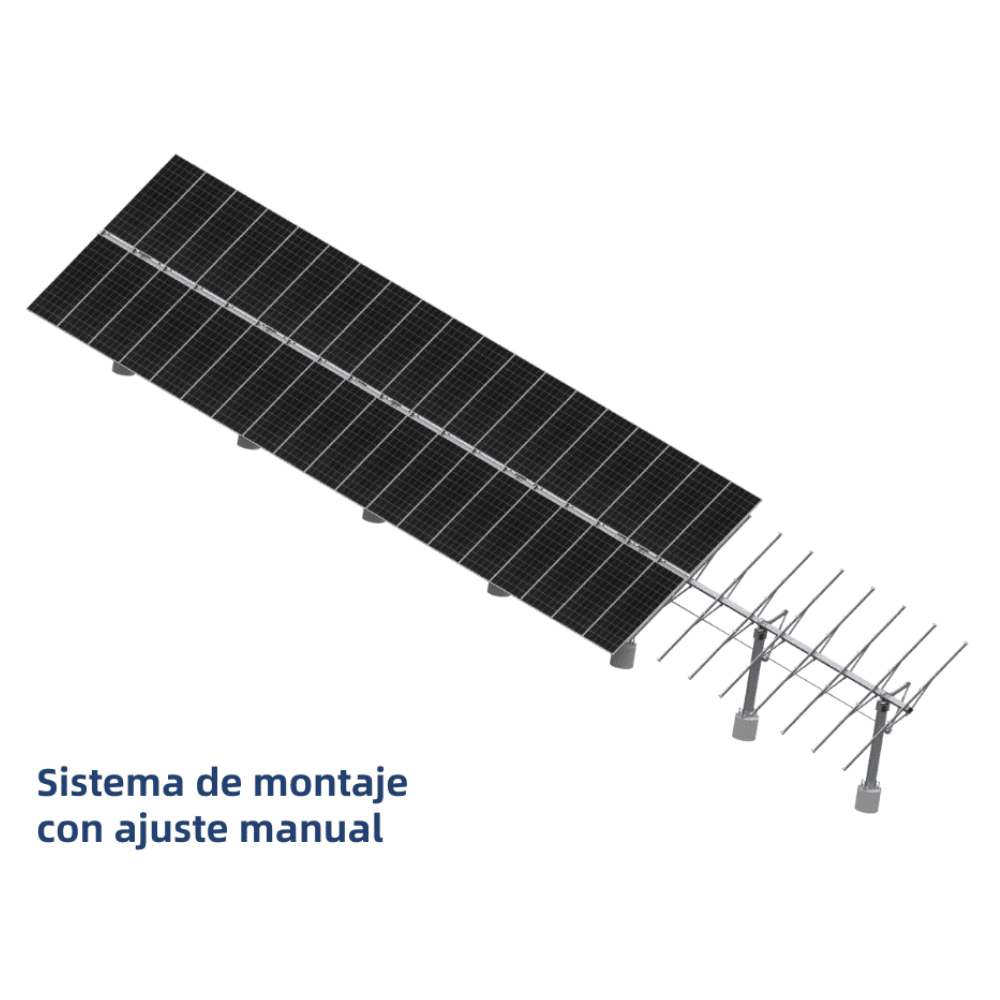
Manual tilt solar structure adjustment 5-45° – Bexie Energy
Solar structure with manual tilt adjustment from 5° to 45°, orientable from south to north according to seasonal irradiation conditions. No motor drive, which reduces the overall system cost and eliminates maintenance of the tracking mechanism. Delivers flexibility and increased energy output compared with fixed-angle structures.

Overview
Bexie Energy’s manual tilt solar structure is a photovoltaic mounting system that allows you to manually adjust the tilt angle of the solar panels between 5° and 45° according to the irradiation conditions of each season of the year. The manual-tilt solar structure offers an optimal balance between production flexibility and technical simplicity, with no need for a motor or control electronics.
The manual-tilt solar structure is designed for installations that want to optimise solar production seasonally without incurring the cost and complexity of motorised solar trackers. With simple manual adjustments two or four times a year, annual output can be significantly improved compared with a fixed-angle structure.
Technical specifications of the manual-tilt solar structure
- Adjustment range: 5° – 45°
- Orientation: south-to-north, manually adjustable
- Drive: manual — no motor
- Wind speed: up to 50 m/s (3s gust, MRI=50Y)
- Snow load: 0.50 kPa
- Module layout: horizontal and vertical
- Material: Q235B / Q355B steel with Zn-Al-Mg coating
How does the manual tilt solar structure work?
The manual-tilt solar structure lets you change the tilt angle of the panels in just a few minutes using a simple mechanical mechanism. The system can be adjusted from south to north depending on the position of the sun in each season:
- Winter: high angle (35-45°) to capture low-elevation solar radiation
- Summer: low angle (5-15°) to take advantage of the high-position sun
- Spring/Autumn: intermediate angle (20-30°) for medium irradiation conditions
With just 2-4 adjustments per year, the manual-tilt solar structure can improve output by between 5% and 15% compared with a fixed-angle structure optimised for the annual average.
Advantages of the manual-tilt solar structure over a fixed structure
- Higher annual output — seasonal optimisation of the capture angle
- No motor — no maintenance costs for the tracking mechanism
- No control electronics — greater reliability and less complexity
- Adjustment in minutes — no special tools required
- Lower cost than motorised solar trackers
- Compatibility with any type of solar panel on the market
Advantages over motorised solar trackers
- No motor — no mechanical breakdowns or repair costs
- No control electronics — no software failures or sensor faults
- No power consumption from the tracker itself
- Lower initial cost
- Simpler and faster installation
- Suitable for off-grid installations with limited access to maintenance
Applications of the manual-tilt solar structure
- Residential ground-mount installations looking to optimise annual output
- Farming estates with available space
- Off-grid installations where maximising output is critical
- Photovoltaic research and education projects
- Installations in areas with significant seasonal differences in irradiation
- Any ground-mount installation where motorised maintenance isn’t viable
Materials and durability
The manual-tilt solar structure uses Q235B/Q355B steel with Zn-Al-Mg coating, which offers significantly higher corrosion resistance than standard galvanisation:
- Durability of over 25 years under normal use conditions
- No additional maintenance of the coating
- Resistant to humidity, rain and temperature variations
- Stainless steel adjustment mechanism for smooth, long-lasting operation
Standards and certifications
- ASCE 7-05 / 7-10 / 7-16 (USA)
- GB50009-2012 (China)
- JISC 8955-2017 (Japan)
- AS/NZS 1170.2-2021 (Australia/New Zealand)
- EUROCODE 0-9 (Europe)
- NSCP 2015 (Philippines)
- NCh 432 (Chile)
Integration with the complete PV system
The manual-tilt solar structure can be combined with our high-efficiency TopCon solar panels, hybrid inverters and storage batteries for an optimised ground-mount self-consumption installation. Calculate the output of your installation with the European Commission’s PVGIS portal. Take a look at the rest of the solar mounting structures in the Bexie catalogue.
Frequently asked questions about the manual-tilt solar structure
How many times a year do you need to adjust the angle?
For most installations, 2 adjustments per year (summer and winter) deliver most of the output benefit. With 4 seasonal adjustments, optimisation can be fine-tuned further. The adjustment takes just a few minutes and can be done without special tools.
How much does output improve compared with a fixed structure?
Depending on the latitude and local irradiation conditions, the output improvement with seasonal adjustment can range between 5% and 15% compared with a fixed structure optimised for the annual average. At high latitudes with large seasonal variations, the improvement can be greater.
Is it easy to adjust the angle manually?
Yes, the adjustment mechanism is designed to be operated by one person without special tools. The process takes a few minutes per row of panels.
Is it compatible with any type of solar panel?
Yes, the manual-tilt solar structure is compatible with most solar panels on the market in standard formats. Contact our technical team to confirm compatibility with your specific model.
What’s the difference compared with a motorised solar tracker?
A motorised tracker automatically adjusts the angle throughout the day following the position of the sun, which can increase output by up to 25-40%. The manual-tilt structure only adjusts seasonally (2-4 times a year), delivering a smaller improvement but without the costs or complexity of the motor and control electronics.