

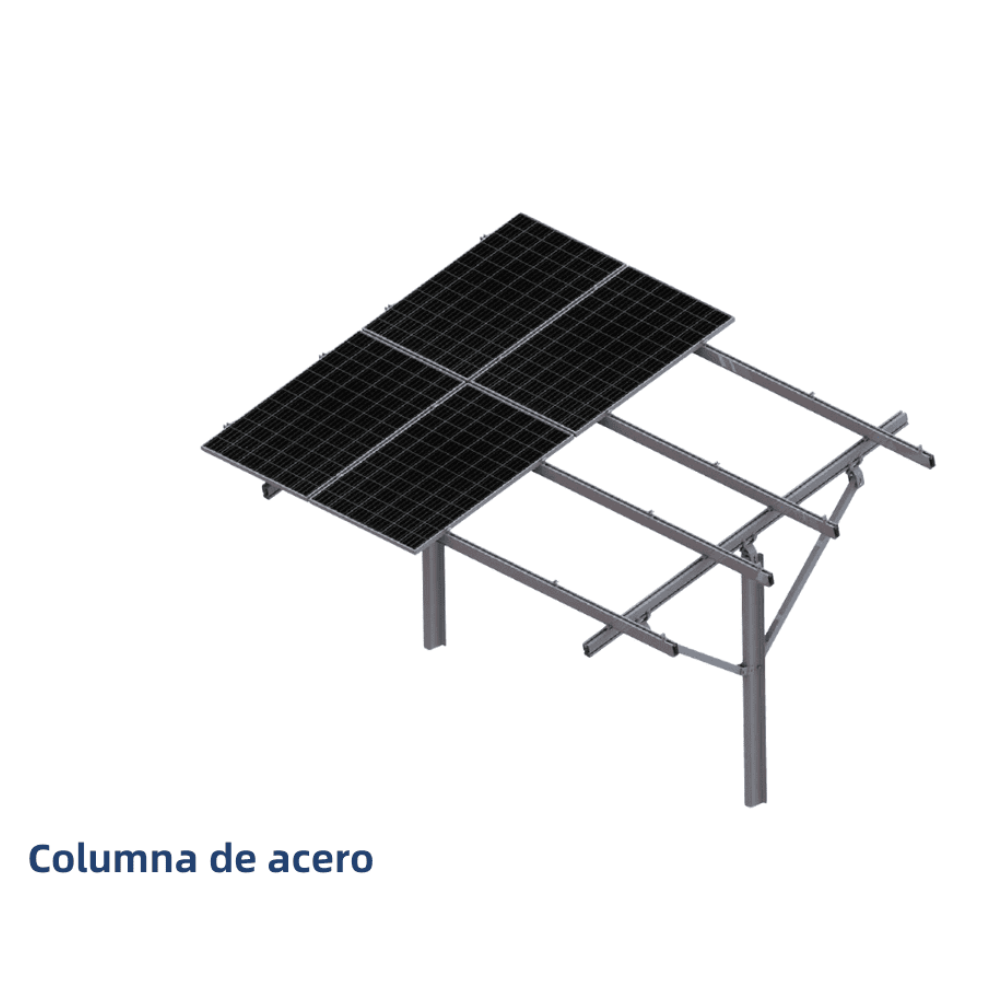
Solar mounting structure for sloped ground | Resistant and certified – Bexie Energy
Solar mounting structure specifically designed for sloped or uneven terrain. Manufactured in AL6005-T6 aluminium and steel with Zn-Al-Mg coating. Adjustable tilt angle from 0° to 60°, compatible with landscape and portrait layouts. Certified to international standards to guarantee safety and reliability on mountainous terrain.

Overview
Bexie Energy’s solar mounting structure for sloped ground is a solar mounting solution specifically designed for installations on inclined, mountainous or steeply graded terrain. Its adaptable anchoring system guarantees the stability and safety of the photovoltaic modules on any type of topography.
Unlike conventional flat-ground structures, this system features reinforced structural elements and anchoring configurations adapted to the slope of the terrain, ensuring the integrity of the installation against wind, snow and seismic loads.
Technical specifications of the solar mounting structure for sloped ground
- Wind speed: up to 70 m/s (3s gust, MRI=50Y)
- Snow load: up to 200 cm
- Tilt angle: adjustable from 0° to 60°
- Module layout: landscape and portrait
- Main material: AL6005-T6 aluminium
- Structural steel: Q235B / Q355B with Zn-Al-Mg coating
- Fasteners: stainless steel
Applications of the solar structure on sloped terrain
- Photovoltaic installations on hillsides and mountainous terrain
- Solar projects in rural areas with irregular topography
- Ground-mount solar plants on steeply graded land
- Agricultural installations on terraced terrain
- Projects in high-mountain areas with high snow loads
- Installations in coastal areas with high wind exposure
Differences compared with the flat-ground structure
The sloped-ground structure features additional elements that distinguish it from the flat-ground version:
- Adjustable levelling system to compensate for terrain unevenness
- Reinforced anchors for greater resistance to lateral forces
- Greater length of piles or foundation screws
- Optimised design to distribute loads evenly on irregular terrain
- Compatible with concrete foundations, driven piles or hybrid systems
Standards and certifications
- ASCE 7-05 / 7-10 / 7-16 (USA)
- GB50009-2012 (China)
- JISC 8955-2017 (Japan)
- AS/NZS 1170.2-2021 (Australia/New Zealand)
- EUROCODE 0-9 (Europe)
- NSCP 2015 (Philippines)
- NCh 432 (Chile)
- More information on European structural standards at Eurocodes JRC.
Materials and resistance in demanding environments
The structure uses anodised AL6005-T6 aluminium for the main profiles, combined with Q235B/Q355B structural steel with Zn-Al-Mg coating for maximum corrosion resistance. This coating is particularly important in mountain installations, where humidity, ice and prolonged weather exposure are critical factors for the durability of the system.
The stainless steel fasteners guarantee the integrity of every joint over the long term, even under extreme weather conditions.
Installation on sloped terrain
The system is designed for installation adapted to the topography of the terrain, with no need for excessive earthworks or prior site preparation.
- Assembly with no on-site welding
- Modular and scalable system
- Adaptable to different degrees of slope
- Compatible with direct foundations, driven piles or ballasting
- Fast installation with standard tools
This minimises the environmental impact of the installation and reduces civil works costs, particularly in areas with difficult access.
Integration with the complete PV system
This structure can be combined with our TopCon solar panels, hybrid inverters and storage batteries for a complete self-consumption installation, even in the most remote or hard-to-access locations.
Frequently asked questions about solar structures for sloped terrain
What degree of slope is this structure suitable for?
The system is adaptable to different degrees of slope through its adjustable levelling system. Contact our technical team for the specific design based on the topography of your terrain.
Do I need civil works to install it on a hillside?
Not necessarily. The system is compatible with piles driven directly into the terrain, which minimises or eliminates the need for civil works and significantly reduces the cost and impact of the installation.
Is it compatible with all solar panels?
Yes, the fixing system is universal and compatible with most photovoltaic modules on the market, both 60-cell and 72-cell formats, including bifacial versions.
Does it withstand wind well in mountain areas?
Yes. It’s certified for wind speeds of up to 70 m/s and snow loads of up to 200 cm, in accordance with the most demanding international standards, which makes it particularly suitable for mountain environments.
How does it differ from the flat-ground structure?
The sloped-ground version features additional levelling and anchoring elements that compensate for the unevenness and guarantee structural stability on irregular terrain. The material specifications and certifications are the same.